
How to Check Criminal History in Crescent City
Crescent City's defining search issue is continuity of custody. Start with identifiers visible in county systems, then ask the likely custodian to confirm where a city report is held.
- Note the incident or arrest date and inspect PCSO Jail View for the arresting-agency label.
- Call Crescent City Hall or PCSO Records to confirm the report custodian before submitting a historical request.
- Search Putnam OCRS for the county criminal case; there is no city criminal-court portal.
- Use Jail View for the booking and custody entry, keeping its identifiers for follow-up.
- Use FDLE for a broader Florida name search or fingerprint Personal Review for your own repository history.
The December 2020 Police Transition
An official city release stated that Crescent City Police duties ceased on December 4, 2020 and PCSO assumed law-enforcement duties while FDLE audited officer training and certification. That historical announcement is important, but it does not by itself prove which office holds every report in 2026.
The archived Crescent City transition release is the primary source for the change. Use the date as a decision point, not as a reason to send every request automatically to one custodian.
The Crescent City Police Department
No current mandatory city police-report form, police portal, app or official crime table was located. City Hall is at 3 North Summit Street, Crescent City, FL 32112; telephone 386-698-2525 and fax 386-698-3467. Posted hours are Monday through Friday, 8 a.m. to 5 p.m., with a noon-to-1 p.m. closure.
Because agency continuity is the central issue, state the event date, location, incident number and arresting agency if known. Ask City Hall whether it holds the requested report or whether PCSO Records should receive it. Do not infer current department structure from the 2020 release alone.
Who Holds a Crescent City Report?
First distinguish a police narrative from a booking or court file. PCSO unquestionably holds county jail bookings, and the Clerk holds filed Putnam cases. The uncertainty concerns the city-level incident or arrest report, particularly around the transition period.
- Record the event date and address.
- Read the arresting-agency line in Jail View when a booking exists.
- Call City Hall and PCSO Records with those facts.
- Ask the contacted office to identify the lawful custodian if it does not hold the report.
This targeted sequence is more reliable than submitting the same broad request everywhere.
Arrests and Bookings in Crescent City
Crescent City arrests are booked into the Putnam County jail. Jail View may show current or released custody, booking and release dates, arresting agency, charges, bonds, booking number, MNI number and a court number. It is the county custody layer, not a city conviction search.
A recent booking can precede a filed case. Charge language may also change after prosecutor review. Keep the booking and court identifiers, then use the Clerk docket for the filed allegation and outcome. A release entry does not mean that a charge was dismissed.
Why Date and Agency Matter
Crescent City searchers face a problem that is less pronounced in Palatka or Interlachen: the local law-enforcement arrangement changed at a known point. A request that omits the date can force staff to reconstruct which custodian handled the event.
- Event date
- Places the report before, during or after the December 2020 transition.
- Arresting agency
- Points toward the office that created the arrest report.
- Booking number
- Identifies PCSO's separate custody file.
- Court number
- Connects a filed prosecution to Putnam OCRS.
These identifiers also help when names are common or spelling varies.
Crescent City Municipal Court Records
Crescent City has no municipal criminal court. Florida's municipal-court tier was abolished, so an ordinance citation or misdemeanor is a Putnam County Court and Clerk matter; a felony is a Circuit Court matter. OCRS supplies the public online route, with Clerk assistance for older, unavailable or nondigitized files.
| Court Name | Putnam County Court; Circuit Court for felonies |
|---|---|
| Case Types Heard | Ordinances, misdemeanors, criminal traffic and felonies according to jurisdiction |
| Case Lookup Channel | Putnam OCRS or Clerk assistance at 386-326-7600 |
| What the Docket Shows | Filed charges, hearings, orders, disposition and sentence when public |
| Copies & Fees | Confirm available documents and current charges with the Clerk |
County Court, Not a City Judge
A city ordinance may sound municipal, but that describes the law involved rather than a separate Crescent City court. The Clerk is the custodian of the filed criminal case. City Hall may hold the ordinance or a related administrative record, not the criminal docket.
Searching by name or exact case number in OCRS is the practical online route. Public access does not expose every document; sealed, confidential and protected information remains restricted. Call the Clerk when a docket is unavailable or an older filing is not digitized.
Where Crescent City Records End Up
The report custodian may depend on date and agency, but downstream custody is clear: PCSO books the arrest, the prosecutor decides what to file, and the Clerk records the case. Qualifying fingerprint arrest and disposition information is reported to FDLE.
Record flow: Crescent City law enforcement › Putnam County Courts › Florida Department of Law Enforcement
Use local or sheriff records for narrative, Jail View for custody, OCRS for prosecution and FDLE for the statewide repository. The products may update on different schedules.
City Record, Sheriff Booking, Clerk Disposition
A complete Crescent City trail often crosses three custodians. The incident report records what officers reported or investigated. The jail file records intake and bond. The court file records the prosecutor's filed charge and final result.
| Question | Best source |
|---|---|
| What did the responding agency document? | Confirmed report custodian |
| Was the person booked or released? | PCSO Jail View |
| What charge was filed and how did it end? | Putnam OCRS or Clerk |
| What Florida history is publicly disseminable? | FDLE record check |
No single line should be read as the whole criminal history.
Crescent City Hall's Midday Closure
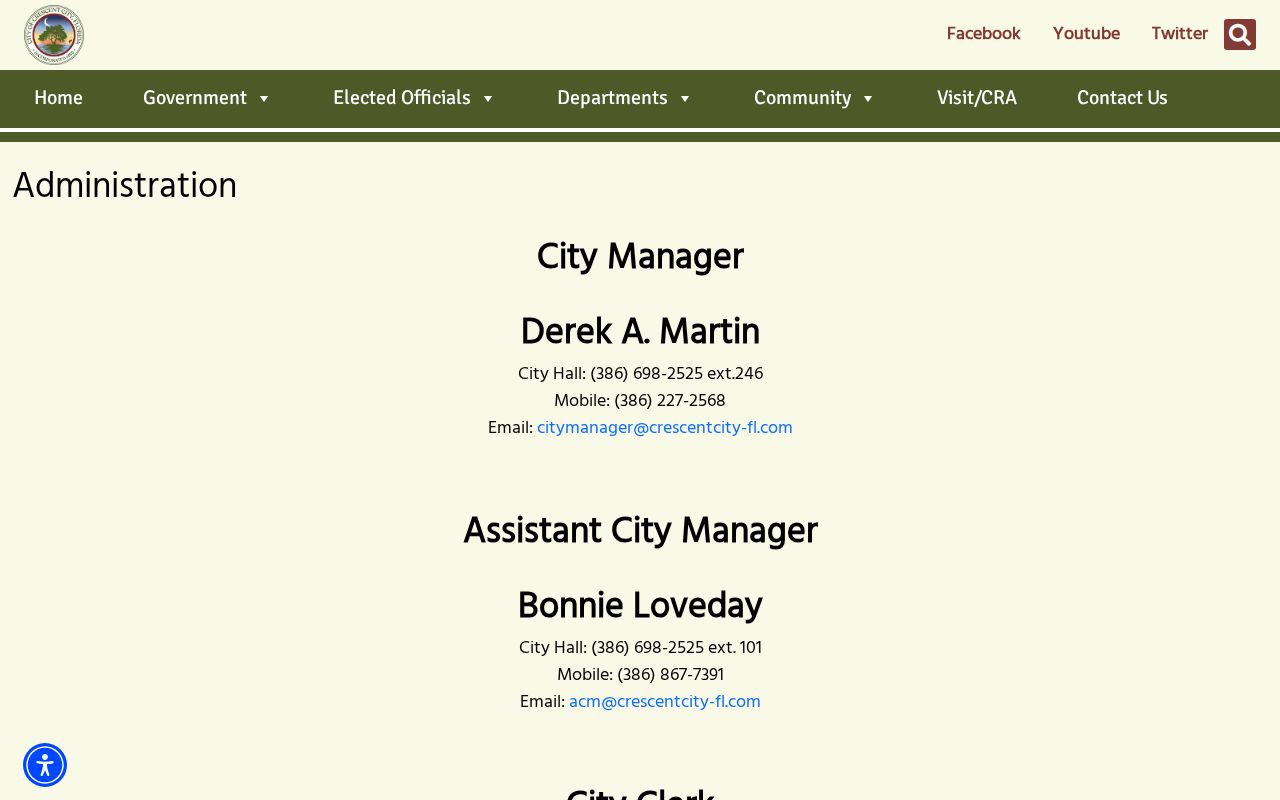
Crescent City's 2025 EDR population estimate is 1,715, and its local administrative counter remains an important routing point. The official city administration page documents that office.
Plan calls or visits around the posted noon-to-1 p.m. closure. Having the event date and agency ready makes the limited counter interaction more useful.
Public Access Rules
Florida's constitutional right of access and Chapter 119 govern city and sheriff records, while court access follows Rule 2.420 and Supreme Court standards. Custodians can redact exempt material but generally must release segregable public portions. Juvenile information, protected victim details, sealed records and active-investigation material can be withheld under specific authority.
Key Statutes:
Florida Statutes §119.07 - governs inspection, copying, redaction and response.
Florida Statutes §943.053 - governs FDLE dissemination.
Florida Rule 2.420 - governs public and confidential court records.
Online absence does not itself prove confidentiality. Ask the correct custodian to confirm existence, exemptions and available portions.
Crescent City's access chain begins with a custody decision that is unusually date-sensitive. A pre-transition city report and a later PCSO response can concern the same location while belonging to different offices. Retention or transfer decisions may further complicate older material, so ask the contacted office to confirm custody or identify the proper custodian.
When no arrest occurred, Jail View may offer no agency clue. Give City Hall or PCSO Records the event date, approximate time, address and nature of the call. Dispatch or incident material can exist without a booking. State whether the request concerns a narrative, CAD entry, 911 audio or other media because those are different products.
The arresting-agency label describes who made an arrest, not who owns every later record. PCSO owns the booking it created even when another agency initiated the arrest. The Putnam Clerk owns the filed docket regardless of the responding agency. Keeping each custodian beside its facts prevents a booking allegation from being presented as a judgment.
Section 119.07 supports release of nonexempt portions after protected information is redacted. A Crescent City requester may ask for the statutory basis and written explanation of denial. Juvenile records, victim identifiers and active-investigation material can require special treatment, while the end of an investigation does not automatically make every detail public.
OCRS access is role-based. Public users can search the Putnam system, while attorneys, registered users and parties have login routes. Those roles do not make every filing visible. If a case number from Jail View produces no docket, verify the number and call the Clerk instead of assuming the prosecution vanished.
A booking number and MNI number belong to the jail system; the court number bridges to OCRS. The incident number belongs to the responding agency. Supplying the wrong identifier to an office can yield a false negative, especially around the 2020 transition when the date and agency are decisive.
FDLE's statewide product is broader than a Putnam case search but less detailed locally. It does not reproduce the Crescent City incident narrative, every booking field or every court document. Its public search is name-based, and FDLE cautions that fingerprints are needed for positive identification.
A person reviewing their own Florida repository history can use free fingerprint Personal Review. Supporting Clerk documents can help challenge a missing or incorrect disposition. That correction route addresses the repository entry; it does not alter the original city report, jail booking or court file automatically.
Jurisdiction provides another check. An ordinance or misdemeanor filing belongs in Putnam County Court, while a felony belongs in Circuit Court. Crescent City Hall may hold the ordinance text or administrative records, but not the filed criminal docket. The Clerk, rather than a city judge or police office, is the court-file custodian.
Timing explains many missing results. A booking can appear before prosecutors decide whether and what to file. OCRS may then use a different offense description from Jail View. A disposition can reach FDLE later still. Searchers should preserve dates and source names instead of combining all entries into one undated summary.
An arrest is not a conviction, and release is not dismissal. The jail entry documents intake and custody. Only the court file shows whether charges were filed and how they ended. Even after dismissal, earlier city or sheriff records do not vanish automatically; lawful sealing or expunction requires a separate Florida process.
For a historical Crescent City event, start by identifying the report custodian, then use the Clerk when the final outcome is the main question. For recent activity, Jail View may supply the fastest agency and booking clues. This sequence respects the 2020 transition without making unsupported claims about today's department structure.
If information appears incorrect, contact the owner of that field. The confirmed law-enforcement custodian addresses its narrative, PCSO addresses the booking, the Clerk supplies court disposition proof, and FDLE handles repository review. The date-sensitive Crescent City problem makes these source labels particularly valuable when requesting correction.
Keep copies of each response and record the search date. A later update may change custody status, docket events or repository disposition without proving that the earlier source was fabricated.