
Criminal Cases in the Putnam County Courts
Circuit Court hears felonies at 515 Reid Street in Palatka. County Court handles misdemeanors, criminal traffic, and ordinance cases at 410 St. Johns Avenue. Florida abolished operating municipal courts, so Palatka, Crescent City, and Interlachen do not maintain separate city criminal dockets. Their qualifying cases route to the Putnam Clerk.
The Clerk's criminal court service identifies the office responsible for filed case records.
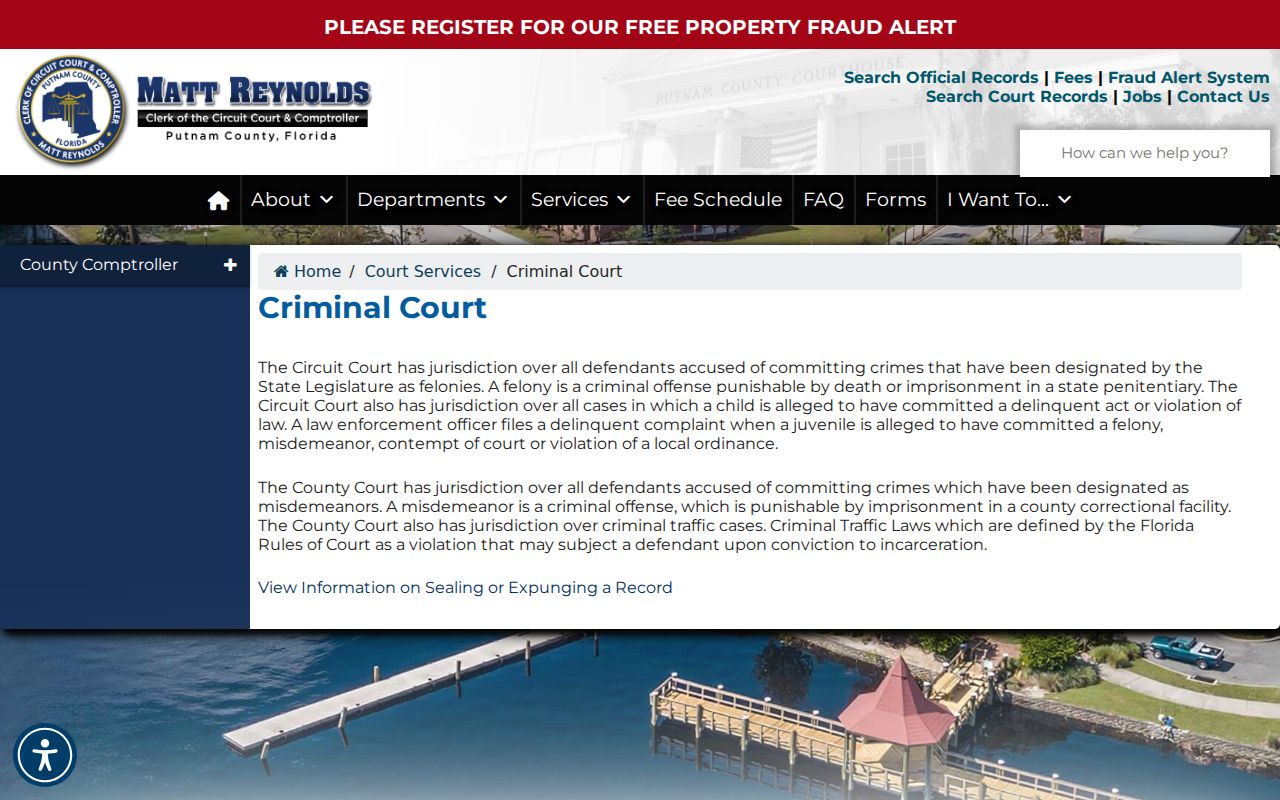
The Clerk, not the judge or arresting agency, is the records custodian for pleadings, docket entries, judgments, and sentences.
Putnam Felonies and Misdemeanors
The building split matters when a reader needs more than an online docket. Felony cases use the Reid Street annex, while misdemeanor and criminal-traffic matters use the St. Johns Avenue courthouse. The operational Clerk customer-service and records counter is in the Tim Smith Building at 107 North Sixth Street, 386-326-7600. Confirm the counter before travel.
The official misdemeanor service page explains the County Court category.
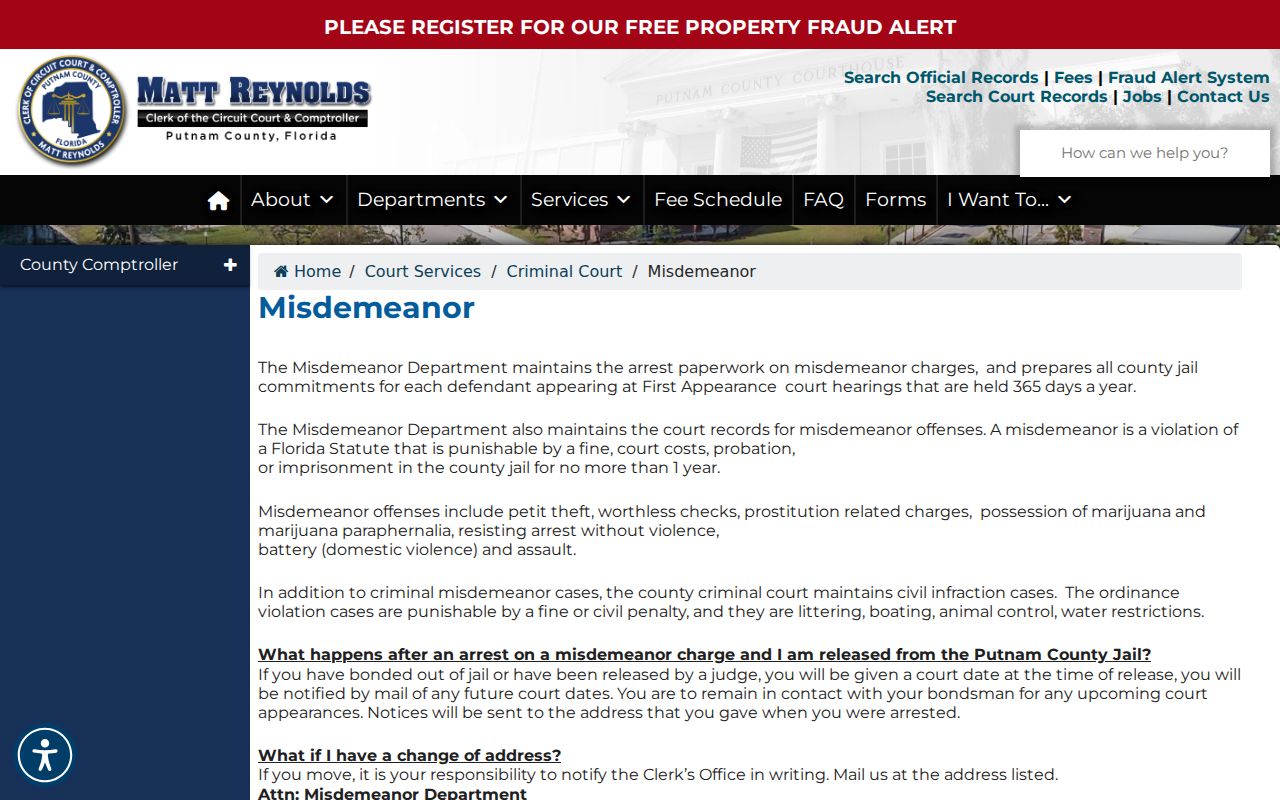
Ordinance charges appear there because no functioning city criminal-court tier exists.
How to Search Case Records
Open Putnam OCRS and choose Public for anonymous access. Attorney, Registered User, and Party Access require login. A broader role changes the account's access category, not the law protecting a sealed or confidential file.
- Open Putnam OCRS and select Public.
- Search by party name or exact case number.
- Compare court, filing date, and case type to select the right file.
- Read the docket in date order and open available documents.
- Ask the Clerk for a missing image, older file, or certified copy.
| Field Label | Type | Required | Notes |
|---|---|---|---|
| Public | Access button | Yes for anonymous route | No account shown on landing screen |
| Name | Search criterion | One route | Official Clerk help confirms name search |
| Case Number | Search criterion | One route | Best when the exact number is known |
| Attorney | Login role | No | User ID and password |
| Registered or Party | Login role | No | Credentials and applicable agreement |
When Putnam OCRS Omits a Filing
Online docket access does not guarantee an image for every filed paper. A document may be older, not digitized, confidential, sealed, or simply unavailable through the public role. Absence from OCRS does not prove that no case or filing exists.
Call the Clerk at 386-326-7600 with the case number, party name, and approximate year. Ask whether the file is public, whether inspection is available, and what copy or certification charge applies. Court confidentiality follows Florida Rule of General Practice and Judicial Administration 2.420 and Supreme Court online-access standards.
Prepare a narrow request instead of asking for every paper under a name. Identify the case number, document title or docket date, desired format, and whether certification is necessary. The Clerk can then distinguish an index inquiry from a copy order. Florida Public Records Law does not erase court-specific confidentiality rules, and a public docket line may remain visible even when the linked document is restricted. Ask what can be released rather than assuming that the online view and the courthouse file are identical.
What the Case File Shows
A Putnam case file answers what the State Attorney filed and what the court did. Portal labels can change, but the following categories form a reliable verification checklist.
| Case Number & Court | County or Circuit Court identity, division, and filing reference |
|---|---|
| Charging Document | Filed counts, statutes, and offense degree |
| Docket Entries | Chronological filings, orders, notices, and events |
| Hearing Dates | Scheduled and completed appearances when public |
| Disposition & Judgment | Dismissal, plea, verdict, adjudication, or other recorded outcome |
| Sentence & Conditions | Custody, supervision, financial obligations, and court conditions |
Reading Putnam Charges and Judgments
An arrest charge, filed charge, and judgment are three distinct lines. Police record the allegation supporting arrest. The State Attorney decides what to file. The court then records amendments, plea or trial activity, adjudication, and disposition. Bond is a release condition, not an outcome.
The State Attorney's Palatka office is part of that filing path.
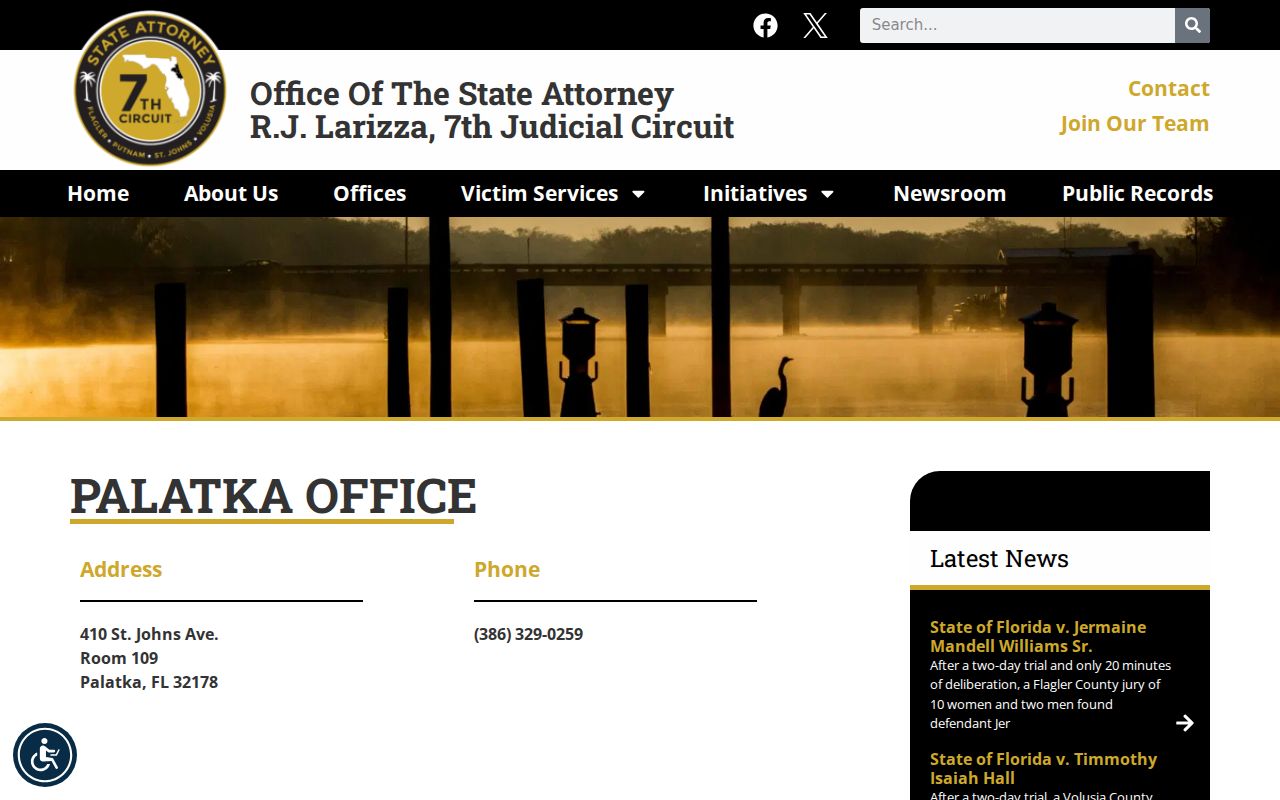
Use the final disposition and judgment documents, not the first arrest label, to understand the case result.
Common docket events also need context. An arraignment records the formal response to filed charges. A continuance moves an event and does not decide guilt. A notice of hearing announces court activity, while an order reflects a judicial ruling. A closed status may signal that active trial-court work ended, but the disposition line and judgment explain why. Financial obligations and probation terms can appear separately from the sentence document. Reading the event chain prevents one isolated entry from being mistaken for the complete outcome.
Stages of a Criminal Case
The prosecutor's filing opens the court-centered record. Arraignment addresses the charge and plea. Pretrial activity can include discovery, motions, negotiation, and hearings. A plea or trial leads to disposition, followed by sentencing when applicable. No reliable fixed Putnam timetable applies to every case.
Case flow: Charges Filed › Arraignment › Pretrial › Plea or Trial › Disposition › Sentencing
Some cases end before every listed stage. A prosecutor may decline to proceed, a charge may be dismissed, or a plea may resolve the case without trial. Other files continue through post-judgment motions or appeal. The docket sequence should be read with the actual orders because an event label alone may not state what the judge decided. If a hearing date has passed but no outcome appears, ask the Clerk whether the event was continued, canceled, or recorded in a document unavailable through public OCRS access.
Putnam Drug Court Case Track
The Seventh Circuit assigns ordinary Putnam felonies to Division 52 and felony Drug Court to Division 25 under its 2026 order. Putnam Adult Drug Court began in 2002, and the Circuit reported 275 graduates in May 2026. Structured treatment, supervision, and court review may lead to incentives described by the court, depending on the case.
The official Drug Court page describes the program.
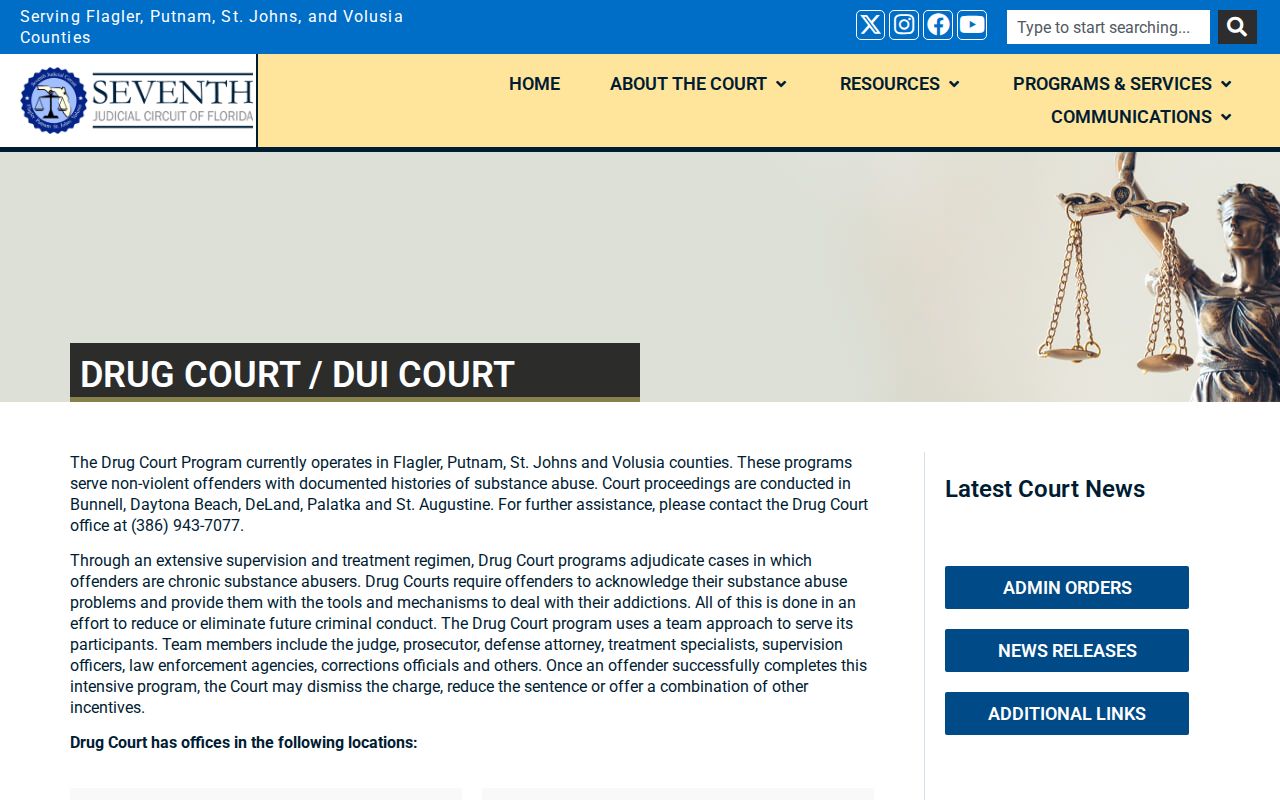
Program participation still belongs in a court file; it is not a separate public criminal-history database.
Putnam also participates in the St. Johns/Putnam Veterans Treatment Court assigned to Division 27. A specialty-court assignment changes the track and services available in an eligible case, not the identity of the Clerk as custodian. Program material should not be read as a promise that a charge will be dismissed or a sentence reduced. The individual docket and signed orders control. When a case moves between divisions, search by the same case number and review assignment orders and docket entries together.
Access & Restrictions
Florida begins with broad public access, but victim information, confidential identifiers, juvenile material, sealed cases, and protected documents may be withheld or redacted. Online role limits do not expand what law permits. If one part is exempt, the public remainder may still be available.
Ask the Clerk whether a nonappearing case is confidential, sealed, undigitized, or outside the online display. A requester can seek the statutory basis for a denial. Never infer a clean history merely from an empty public search.
A sealed case and an undigitized case can look similar from outside the portal, yet they require different responses. The Clerk can confirm whether public access is legally restricted without disclosing protected contents. An older paper file may instead be available by inspection or copy order. Juvenile records follow confidentiality rules and should not be expected in the ordinary adult criminal search. Never use a missing browser result as proof that a named person has no Putnam criminal case history.
Florida Constitution Article I, Section 24 supports open government, and Chapter 119 governs many agency records. Court files also operate under judicial access rules. Protected victim details, confidential identifiers, sealed material, and juvenile information should not be expected in a public browser result. When only a portion is protected, redaction can allow release of the balance. A Clerk response explaining that a document is unavailable online is not always a final denial of inspection, so ask whether another public format or counter review exists.
Federal Cases Outside Putnam OCRS
Putnam lies in the Jacksonville Division of the U.S. District Court for the Middle District of Florida. Federal cases do not appear in Putnam OCRS. PACER requires registration and generally charges $0.10 per page, subject to its caps and quarterly fee waiver rules.
PACER is the federal docket source.
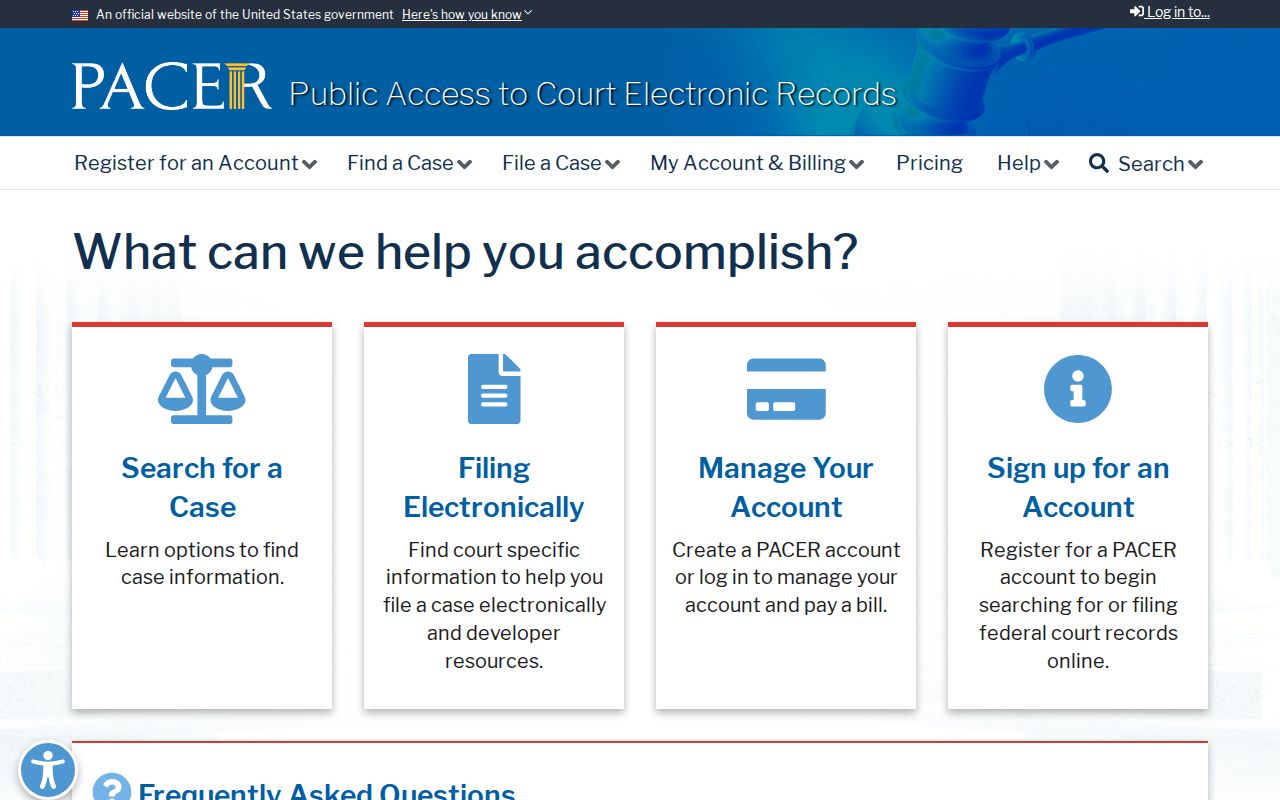
Use the federal system only for federal filings; state and county records remain with their Florida custodians.
The nearest federal clerk location is the Bryan Simpson U.S. Courthouse, 300 N. Hogan Street in Jacksonville. Courthouse terminals can provide docket chronology. Research indicates clerk-made copies cost $0.50 per page and self-made terminal copies cost $0.10 per page, but confirm current terms before ordering. Federal custody is searched through the Bureau of Prisons, not PCSO Jail View or Florida Department of Corrections. A federal release notation likewise does not resolve possible state or county custody. Always match the jurisdiction, case number, and court before ordering documents. Similar party names across state and federal systems are not proof of identity.